A Call to Action for Our Community
19 March 2026
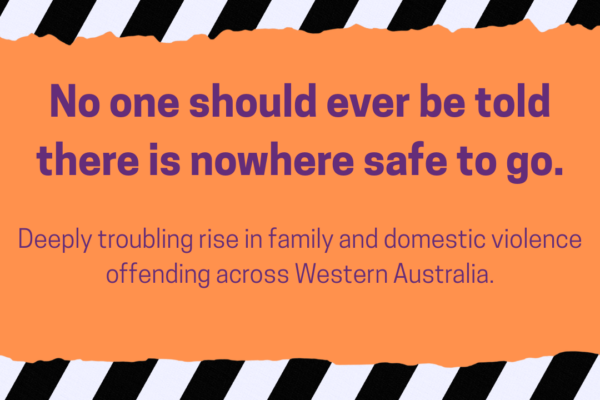
Newly released figures from the Australian Bureau of Statistics (ABS) show a deeply troubling rise in family and domestic violence (FDV) offending across Western Australia, underscoring the hideous reality and abuse that victim-survivors have been experiencing for years.
According to the Australian Bureau of Statistics Recorded Crime – Offenders data, the number of FDV‑related offenders proceeded against by police in WA has surged to 11,908 , a 20% increase in just one year.
These offenders now account for 28% of all individuals proceeded against in the state, with an FDV offender rate of 448 per 100,000 people, compared to 385.5 in 2023-24.
The majority were charged with acts intended to cause injury (52%), and 79% of offenders were male, with the male offender rate almost four times higher than the female rate.
These numbers paint a clear picture; violence rooted in gender inequality continues to escalate, and the systems intended to protect victim‑survivors are under increasing strain.
The impact of the abuse that victim-survivors experience and the barriers and injustice faced within systems and our community is inexcusable and must be a priority for real immediate action.
What We’re Seeing on the Frontline
For services like ours providing refuge accommodation and FDV support, these statistics are not abstract, they reflect the lived experiences of the victim-survivors who walk through our doors every day.
Last financial year alone, we provided almost 14,000 nights of safe accommodation to 125 individuals seeking safety. Yet, despite operating at full capacity, 640 additional requests for refuge or support could not be met, either due to being completely full or because the service model available did not match the individual’s safety needs.
Behind each of those 640 unmet requests is a person. Most often a woman and her children, making the courageous and life altering decision to seek safety. Being unable to offer them a secure place is one of the most devastating realities of our work.
And this pressure is not isolated to accommodation. Every one of our programs, outreach, safety, therapeutic support, family services, legal and systems navigation; is experiencing rapidly rising demand. Every day we are stretched, and it is a challenge we face that we are not always fully funded to deliver what we do.
We are actively trying to increase our reach and look at innovative ways to do so at every opportunity.
We want to do more, expand our services and support but we are unable to do so.
A Gendered, Rights‑Based Understanding of the Crisis
FDV is not random, nor is it inevitable. It is a gendered violation of human rights, driven by deeply entrenched attitudes, power imbalances, and structural inequalities. These new statistics again reinforce what decades of evidence have shown:
- Gender norms influence patterns of harm.
- Females continue to bear the overwhelming burden of violence in their homes.
- Changing this requires accountability, cultural shifts, and investment at all levels of society.
A Call to Our Community
These numbers should galvanise us. They should disturb us. And they should move everyone to act.
Ending FDV is not the responsibility of victim‑survivors. It is the responsibility of all of us.
We are calling on:
- Individuals and communities
To challenge gender‑based bias, call out disrespect, and create cultures of safety in homes, workplaces, sporting clubs, and social circles. - Businesses and philanthropic partners
To invest in prevention, frontline capacity, and lived‑experience‑informed programs that keep victim-survivors safe. - Local, state and federal governments
To expand funding for crisis accommodation, long‑term housing, and wrap‑around support — so no one is turned away into danger.
We have solutions and opportunities for everyone to help and act.
Please contact us for more information.
We Cannot Keep Turning People Away
The latest ABS data confirms what frontline services already know; family and domestic violence in WA is rising at an alarming rate, and demand for safety far exceeds supply.
We are committed to showing up for every person who seeks our help.
But without sustained, meaningful investment, the gap between those needing safety and the services available to protect them will continue to widen.
No one should ever be told there is nowhere safe to go.
If you would like to contribute to our services please visit our donation page.

To find out how you can partner with us, please contact us on 1800 870 149 or email [email protected]